Start with its roots.
The djembe, also written jembe, comes from West African musical traditions, with strong Malinke and broader Mandé connections. Its story includes skilled makers, teachers, dancers, and communities—not just an instrument shape.
Learning a named traditional rhythm? Learn its name, region, context, and teacher too. A short online exercise is a starting point, not the whole tradition. Paz drums are made by Justin in Spokane; that is distinct from claiming West African manufacture or a teaching lineage.
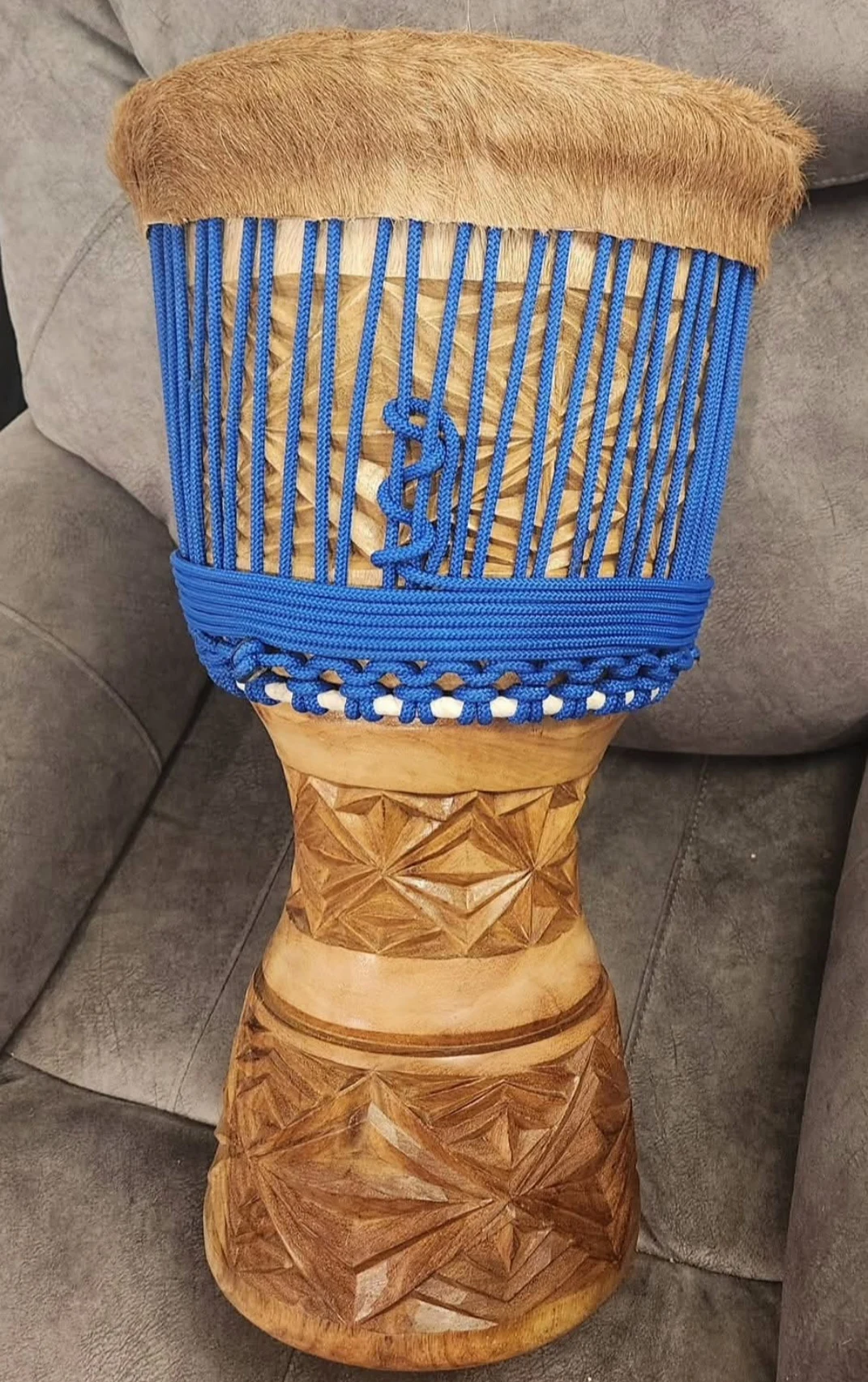
Know the parts you’re listening to.
- Head: the playing surface, traditionally animal hide; synthetic heads also exist.
- Bearing edge: the shell rim supporting the head.
- Bowl, throat, and foot: the upper chamber, narrow passage, and open lower section.
- Rings and rope: on a rope-tuned drum, these hold the head and apply tension.
Reference: Drum Africa — Djembe design and sound · Remo — Key-tuned djembe guidance
Bass, tone, and slap.
Bass is the low voice, tone the fuller open voice, and slap the bright, cutting voice. The player’s contact and release matter. One drum can speak differently in different hands.
Start by listening to Justin’s performance, then try the first-strokes guide. The video is a general performance, not a demonstration of every drum in the gallery.
A LITTLE LISTENING MAP
Same head.
Different voices.
Choose a voice to see where to begin.
Start near the center.
Let your hand rebound so the head can ring. Listen for the low voice rather than chasing volume.
A position map, not a full hand-technique lesson. Tone and slap share the edge area; touch and release make the difference. Explore stroke technique ↗
Reference: Djembefola — Bass, tone, and slap technique
YOUR NEXT QUESTION
Make it about your drum.
Tell Justin what you’re looking for, or ask about a particular instrument. Availability, specifications, services, and terms are confirmed in conversation.
Explore his work ↗